
What Does It Mean to Share a Brain?
A joke between spouses turned out to contain more truth than I realized.

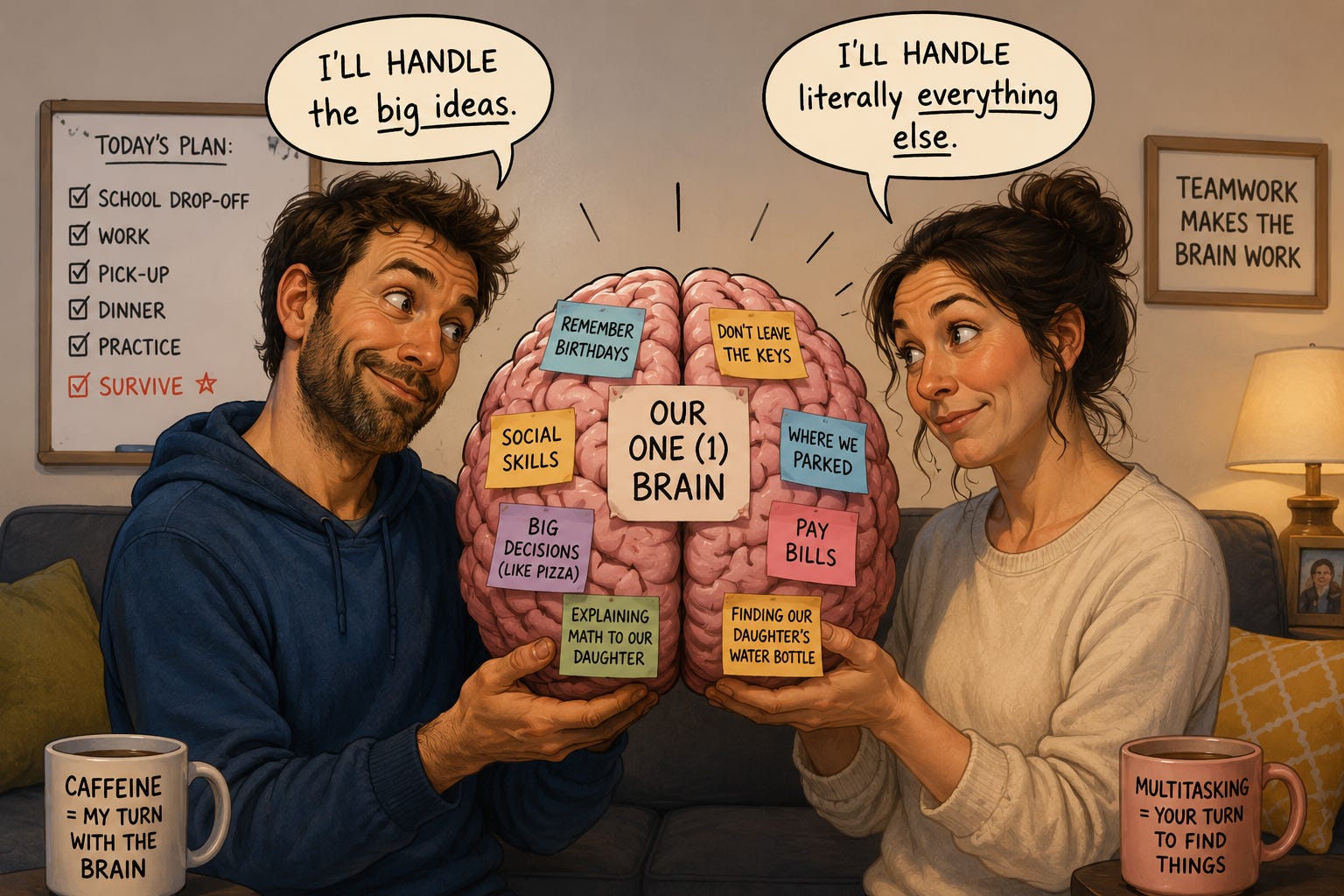
My wife and I sometimes joke that we share a brain.
I know what you’re thinking — many couples have this experience. Long-term spouses and significant others say that they can finish each other’s sentences and claim they know their partners better than their partners know themselves.
But we actually mean something different. We share a brain in the sense that between the two of us, we have 1 fully functioning brain, and we share it, passing it back and forth as needed. One of us remembers what the other forgets. One notices the flaw in a plan that the other thought was foolproof. One remembers where we’re supposed to be while the other remembers what we’re supposed to bring. We compensate for each other’s gaps in memory or planning or critical thinking. We literally share a brain. Without this sharing, we wouldn’t make it through Tuesday.
Chuckle all you want. You probably share your brain with other people too in a myriad of other ways. If you’re enough of a Taylor Swift fan that you can instantly sing along to her lyrics, you share something stored in your brain with hundreds of millions of other people. If you attended a New York Knicks watch party during their glorious 2026 championship run, you all experienced something similar. You were in a crowd of people directing their attention toward the same thing, reacting together, while sharing emotions, chants, hugs and hand gestures, a common set of meanings, memories, hopes, and aspirations.1
Even something as ordinary as sitting in a classroom, listening to someone explain an idea, and remembering it afterward is a kind of brain sharing. Something that once existed in one person’s mind now exists in yours. Humans outsource memory and cognition to other people, synchronize attention and emotion in groups, and accumulate knowledge culturally across generations.
We store pieces of our knowledge in other people. We rely on spouses, friends, colleagues, teachers, books, institutions, and (most recently in our species’ history) electronic devices like personal computers and smartphones, to know things so that we don’t have to know everything ourselves. We pass ideas from one mind to another and from one generation to the next. Much of what any of us “knows” is really part of a much larger network of knowledge that no single individual could possibly contain.
Sometimes my wife and I say that we share a brain in jest, typically when one of our brains isn’t functioning at 100 percent so the other has to compensate. Sometimes we say it with gratitude (“thank the gods there’s another half of this operation”). And sometimes we say it to pat ourselves on the back after accomplishing something together that neither of us would have done solo.
But the joke contains something true.
We all share our brains, all the time. There’s nothing embarrassing about depending on other minds. Human beings are able to accomplish extraordinary things precisely because none of us has to think, remember, discover, or understand everything alone.
And that brings me to this Substack page.
I’m a social psychologist by training, and I now work as a researcher, teacher, and science communicator. I’m interested in how people think and behave, especially in relation to close others or large groups, and how we construct our brains together. That takes me in a lot of directions.
Here, I’ll share some of my brain with you: thoughts about psychology and my own research (and that of my colleagues), but also politics, higher education, relationships, social media, pop culture, music, movies, sports, and whatever else seems interesting enough to think about.
I hope you’ll share some of your brain with me too. Life is more fun that way.
Edit: my wife suggested another example. In the Jewish tradition, following someone’s death, the shiva is a week-long period of mourning when friends and family come together and sit in a community to share stories and memories of the deceased. Everyone shares a bit of their own thoughts and feelings, which collectively paints a fuller picture of the loved one who died. This is salient for us because her very close friend recently passed away.